
One-stop comprehensive solution provider
Short answer: Ask for the 316L material test report and the PVD plating thickness plus salt-spray result before you negotiate price — rings run roughly $0.23–$3+ at 50–500 units per style, and some factories accept as few as 3 pieces for a stock design. If the supplier cannot produce the report for the exact batch, move on.
Stainless steel jewelry is the quiet workhorse of the jewelry trade: rings, necklaces and sets that sell at gift prices, reorder constantly, and start at MOQs a small DTC brand can actually afford. It is also the category where the most common buyer mistake costs the least per piece and the most in reputation — a “316L” ring that is really 304 steel, or a gold finish that fades after three weeks of wear. Both problems are invisible in a supplier’s photos and obvious in a sample, which is why this guide starts with material and plating and only then talks about price. Black Friday is November 27, and TikTok data says 22% of US users plan to buy accessories during the sales — gold jewelry is one of the season’s hot picks — so if you want stock for the holiday rush, this is the week to order samples.
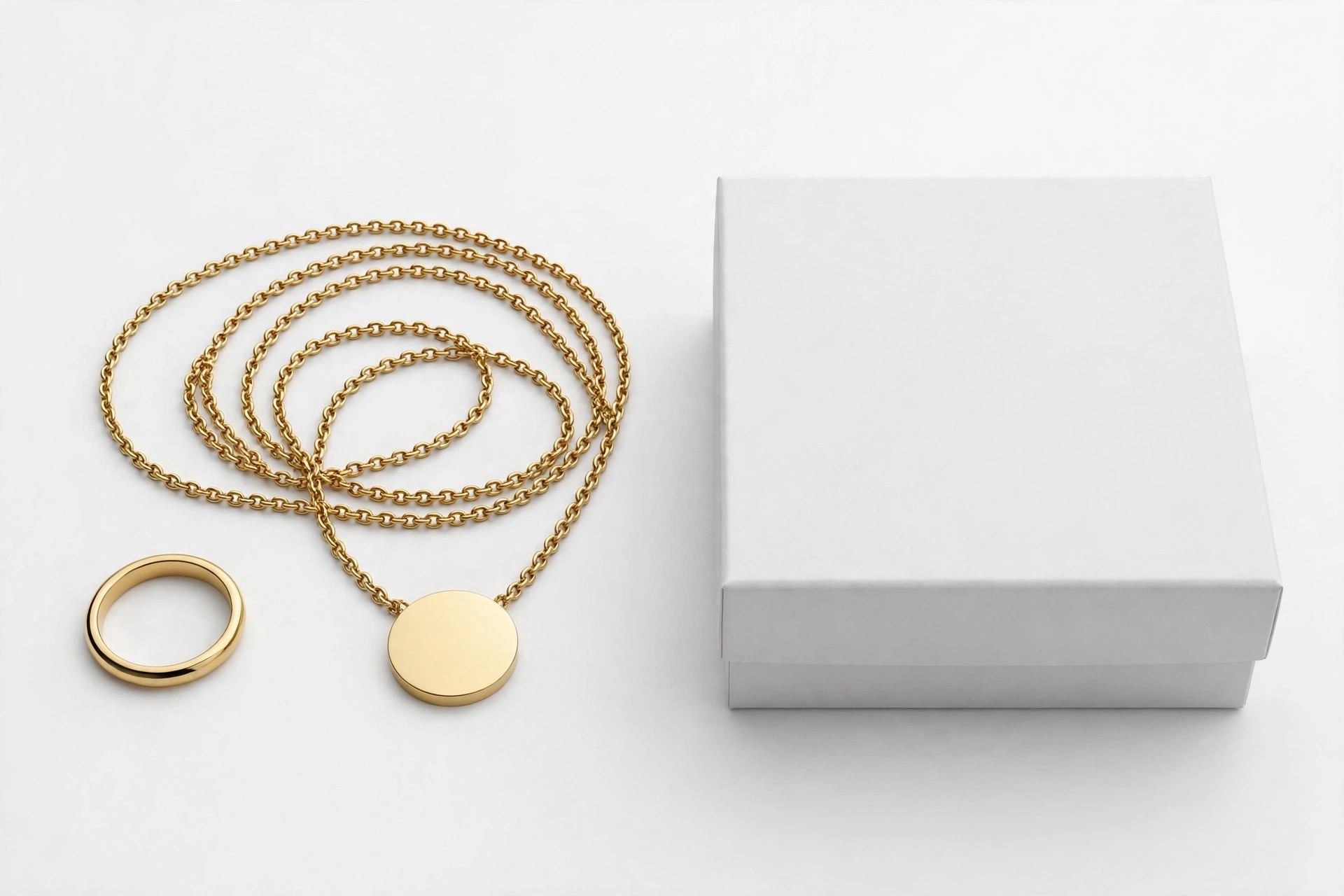
1. 316L or 304? Get the material report, not the listing title
The first check is the steel grade, because it decides whether the piece survives daily wear. 316L is the marine-grade stainless buyers ask for: it resists tarnish and skin reactions better than 304, which is the cheaper, more common grade. The switch is the classic trick in this category — a listing says 316L, the shipment is 304, and nobody can tell by looking. Do not rely on a magnet or a colour check; neither proves the grade. Ask for the material test report for the exact batch, and check the nickel and chromium content on it. A factory that actually buys 316L will send the report without a fuss; a trader who cannot name the mill will change the subject. For a first order, also ask whether the factory does its own material incoming check or just trusts its steel supplier — the answer tells you how seriously they take the grade claim.
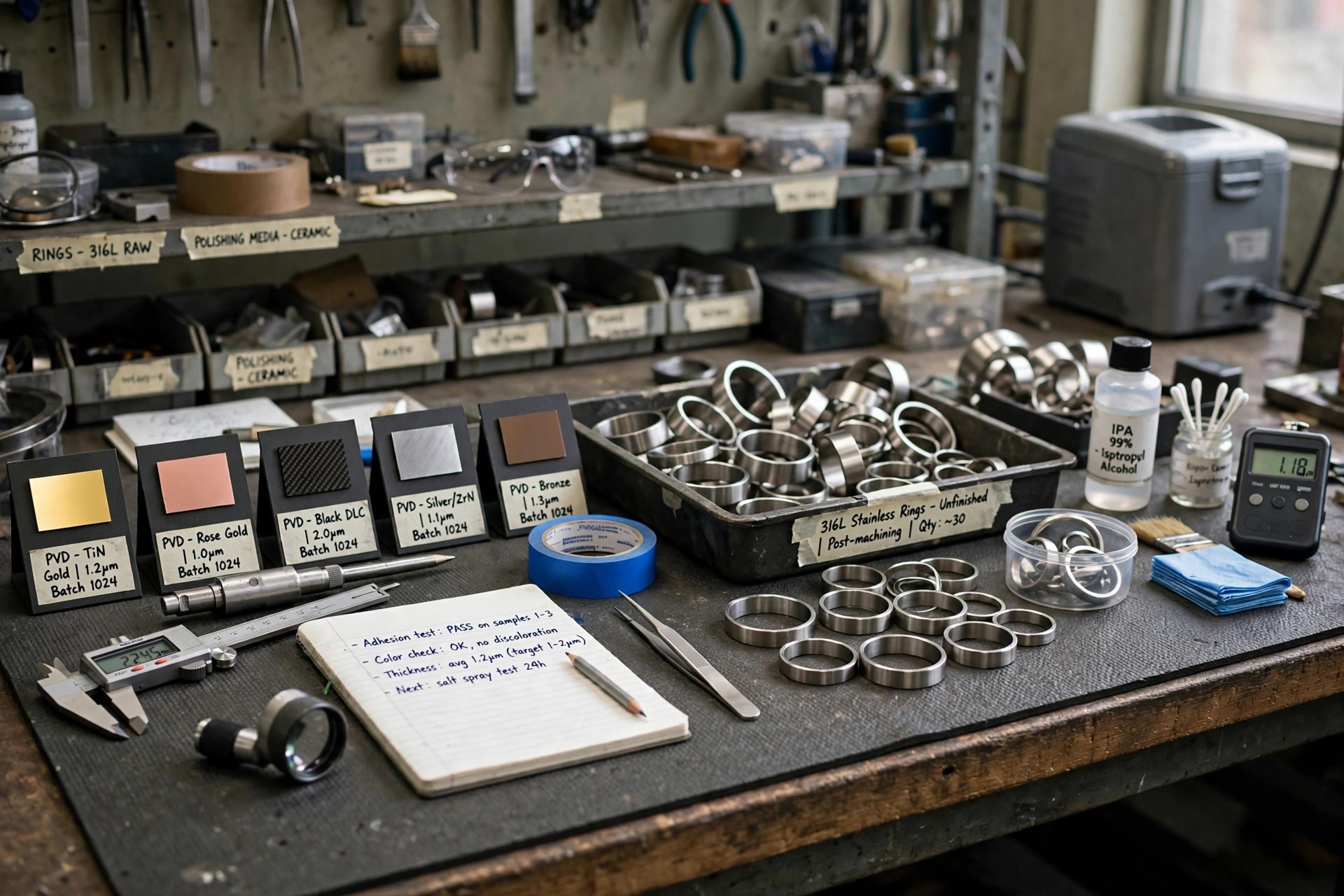
2. PVD or IP plating? The finish decides whether the gold lasts
The second check is the finish, because it decides whether the gold colour is still there in a month. PVD plating bonds the gold-coloured layer to the steel in a vacuum chamber; it is harder, thicker and far more wear-resistant than IP plating, the cheaper ion-plating process that looks identical on day one and fades after a few weeks of wear. Ask every supplier two things: which process they use, and the plating thickness plus the salt-spray test result. A PVD finish should come with a salt-spray report showing real hours, not a bare claim of “waterproof” or “tarnish-free”. If a quote is far below the rest, it is almost always IP plating sold as PVD, or a thinner coat than stated. Rings take the most abuse of any jewelry piece, so test the finish on a ring sample first — it will show wear before a necklace does.
3. Price and MOQ: low per piece, but check the per-style minimum
Peer listings in November 2026 put ring-style pieces roughly in the $0.23–$3+ range, at MOQs of 50–500 units per style, with some factories accepting as few as 3 units for a stock design. That low floor is what makes this category friendly to new DTC brands and TikTok sellers: you can test a design with a handful of pieces instead of committing to a full run. But read the MOQ carefully — it is per style, not per order, so five designs at 50 pieces each is 250 pieces, not 50. Custom engraving, logo tags and gift-box packaging are usually low-cost at 100+ units, which is where private label starts to make sense. Treat the price ladder as a starting point, not a quote: a factory quoting $0.23 for a “PVD gold” ring is quoting you a different product than a factory quoting $3, and the sample will show which one it is.
4. The three sample tests that catch bad jewelry
Order samples from three suppliers and test them the same way. First, wear-test the finish: wear the ring daily for two weeks, wash your hands with it on, and check whether the gold colour thins at the edges — fading that shows in two weeks will be a return in two months. Second, check the build: pull the chain and clasp firmly, check the ring’s inner band for rough edges, and confirm the necklace length and ring size match what you ordered — sizing and clasp failures are the top reason for complaints in this category. Third, check the paperwork before you pay anything: ask for the material test report, the plating thickness and salt-spray result, and REACH and California Proposition 65 documentation for the exact finish, plus a nickel-release test for pieces that touch skin. A supplier who has shipped to the EU or US before will have these files ready; one who has to “ask the factory” for them is telling you they have never been asked.
5. Private label and the Black Friday deadline
Private label is straightforward here and cheap at small volumes. Custom engraving, logo tags and gift boxes are usually low-cost at 100+ units, and a stock design with your logo can start from as few as 3 pieces at some factories. Lead time is short compared with most categories, which is why this line works for Black Friday: order samples this week, approve the finish, and place the bulk order while there is still time for production and air freight before November 27. For the EU and US, confirm the nickel-release and REACH paperwork before you pay the deposit — a piece that cannot legally be sold in your market is worthless however cheap it is. For the full inspection checklist, see our guide to pre-shipment inspection.
6. FAQ
Will the gold colour fade?
PVD gold lasts far longer than IP plating, but no finish is permanent. Expect a good PVD piece to hold its colour through months of daily wear; if a sample fades in two weeks, the plating is thin or it is IP, not PVD. Test it on your sample before you commit to volume.
Can I really order just 3 pieces?
Some factories accept 3 units for a stock design, but that is a sample-size order, not a bulk price — the per-piece price at 3 units will be higher than at 500. Treat tiny MOQs as a way to test a design, not as your production run.
What paperwork do I need for the EU and US?
Ask for the material test report, plating thickness and salt-spray result, REACH documentation, California Proposition 65 documentation for the finish, and a nickel-release test. For the full checklist, see our inspection guide.
Start with samples, not with a bulk order
Stainless steel jewelry rewards buyers who check material and plating before they negotiate price. Test three samples on the same spec sheet, wear the ring for two weeks, and only then talk volume. See our Stainless Steel Jewelry product page for a live example of this category. If you want help finding and vetting suppliers for this category, our $129 Sourcing Trial covers five suppliers, a side-by-side comparison, and a recommendation — see our Pricing page for details.
How to source dash cams from China in 2026: dual 4K front + 1080P rear, STARVIS sensor night tests, loop recording and G-sensor locks, heat and parking-mode che···
Как заказать пусковые устройства из Китая в Россию в 2026 году: реальные и заявленные пико···

How to buy from 1688 without speaking Chinese in 2026: browser translation, image search and Chinese keywords, reading price tiers and supplier badges, landed c···