
One-stop comprehensive solution provider
Short answer: Buy a carbon-fibre, 3-zone vest with a 10,000 mAh battery and a UN38.3 report — mid-range $18–$30, MOQ 2–500 units depending on how custom the order is — and test three samples (battery runtime, wash test, paperwork) before ordering volume. Sea freight for Christmas is already cut off, so this season’s orders go by air.
Heated vests are the winter product to move on right now. Outdoor retailers, workwear buyers and winter gift buyers are ordering in November, and the window is short: sea freight for Christmas is already cut off, so this season’s orders go by air or not at all. A USB heated vest looks simple — a vest, a battery pack, a few heating pads — but the quality gaps are exactly where a buyer gets burned: a battery without a UN38.3 report gets stopped before it leaves China, heating zones that go cold after two washes turn into returns, and a vest that only heats the chest while the listing promises full-body warmth is a dispute waiting to happen. This guide covers how to tell a good one apart before you order.
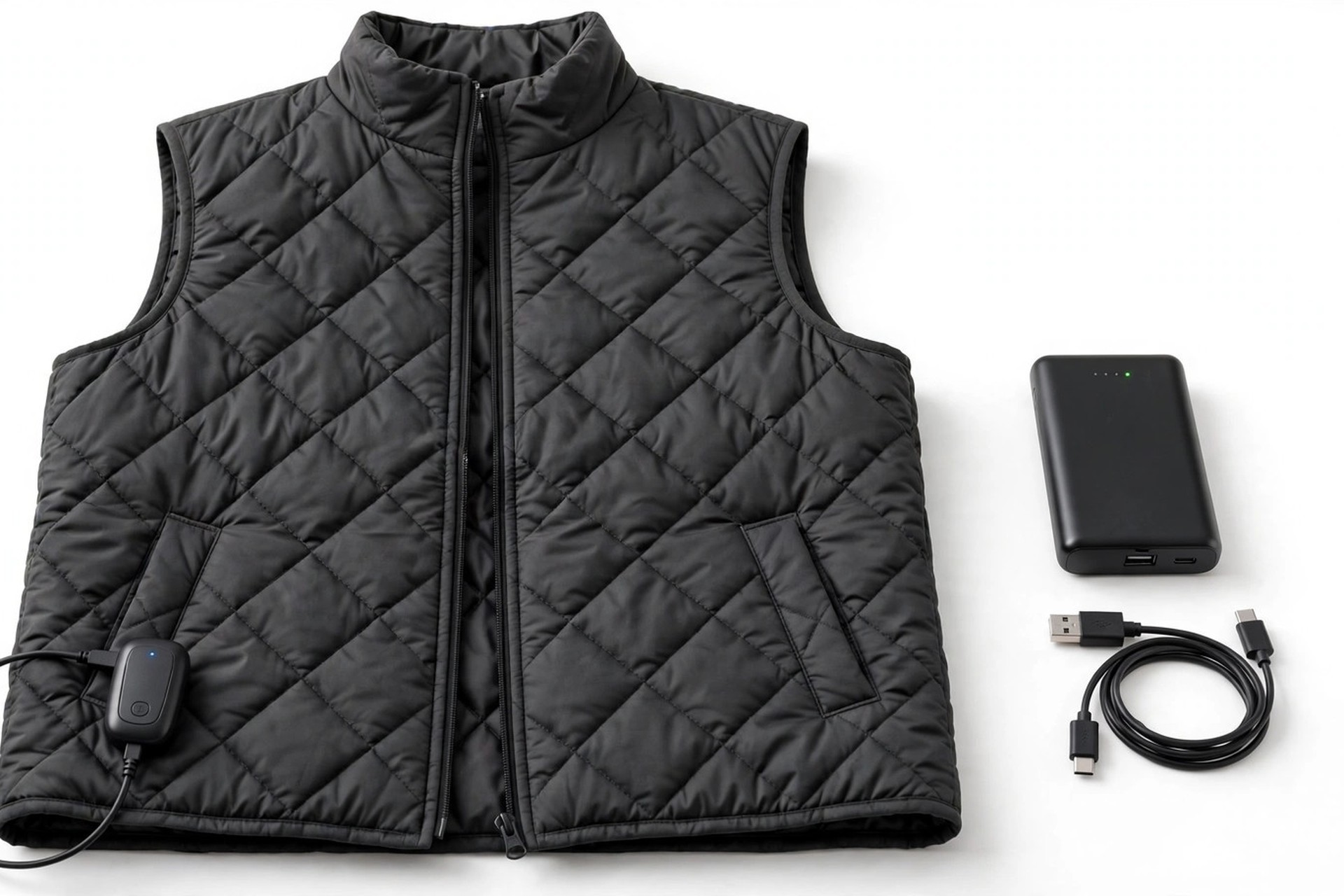
1. Where the factories are, and what each place does best
A heated vest is two supply chains in one garment, and the factory you want depends on which half matters more to you. The heating elements, battery packs and controllers come from the electronics chain in Shenzhen and Dongguan — the same factories that make power banks and wearable batteries. The garment half comes from the apparel chain in Zhejiang and Jiangsu, where factories cut and sew outerwear at volume. The best suppliers are the ones that control both: a garment factory with its own heating-element line, or an electronics factory with a sewn-goods partner it has worked with for years. If a supplier buys the battery from one place, the heating pads from another and the vest from a third, ask who tests the finished product — a trader who assembles from three vendors will change the subject, while a factory that owns the line will show you its test bench.
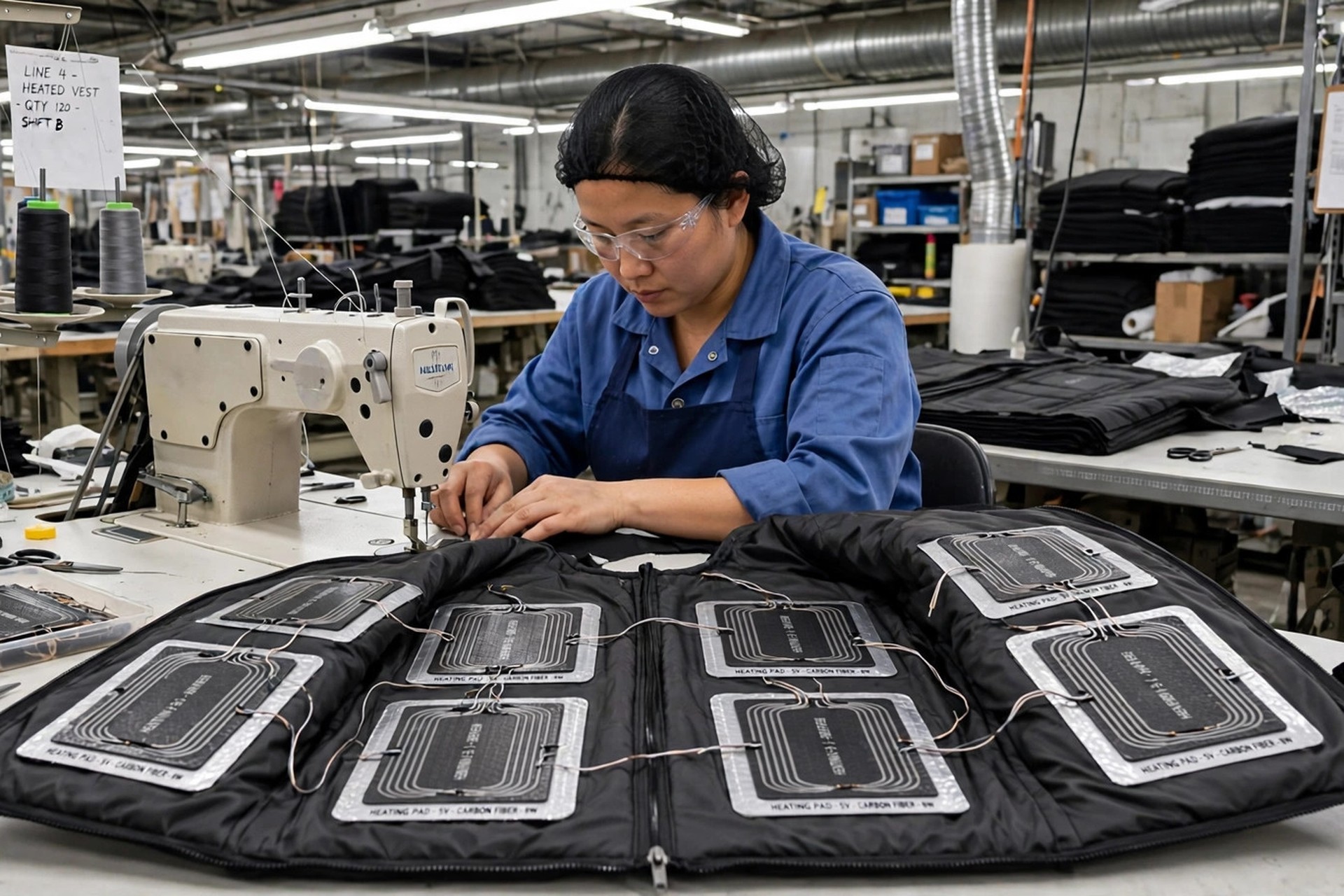
2. Compare the same spec, not the same price
Listings advertise wildly different prices for what looks like the same vest. The only fair comparison is a fixed spec sheet. Ask every supplier to quote this exact configuration: heating zones across chest and back, stated number of zones, carbon fibre heating elements, battery capacity in mAh, three heat settings, removable battery pack, and washable after the battery is taken out. Then compare the quotes side by side.
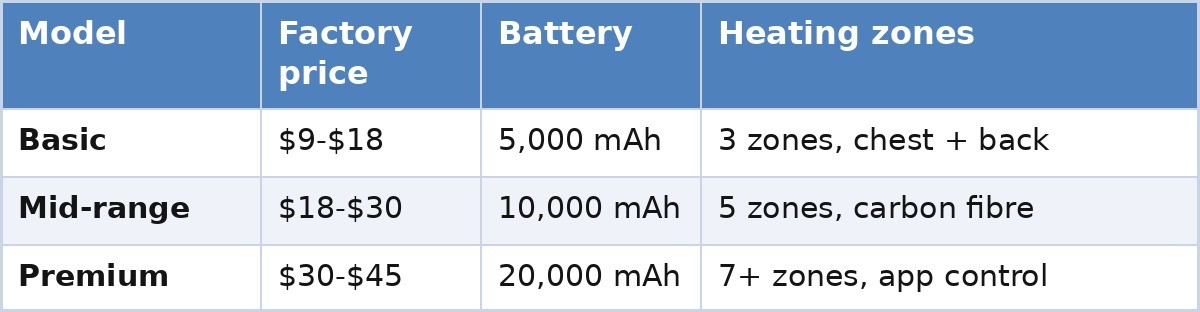
Prices above are peer listing ranges, not ChinaSift quotes — confirm with suppliers at order time. The pattern to watch: a quote far below the range almost always means a smaller battery, metal wire elements instead of carbon fibre, or fewer heating zones than the listing claims. Also check the battery’s cycle life — a cheap pack that holds a charge for one season and dies the next will cost you repeat orders, not just returns.
3. The three tests that catch bad samples
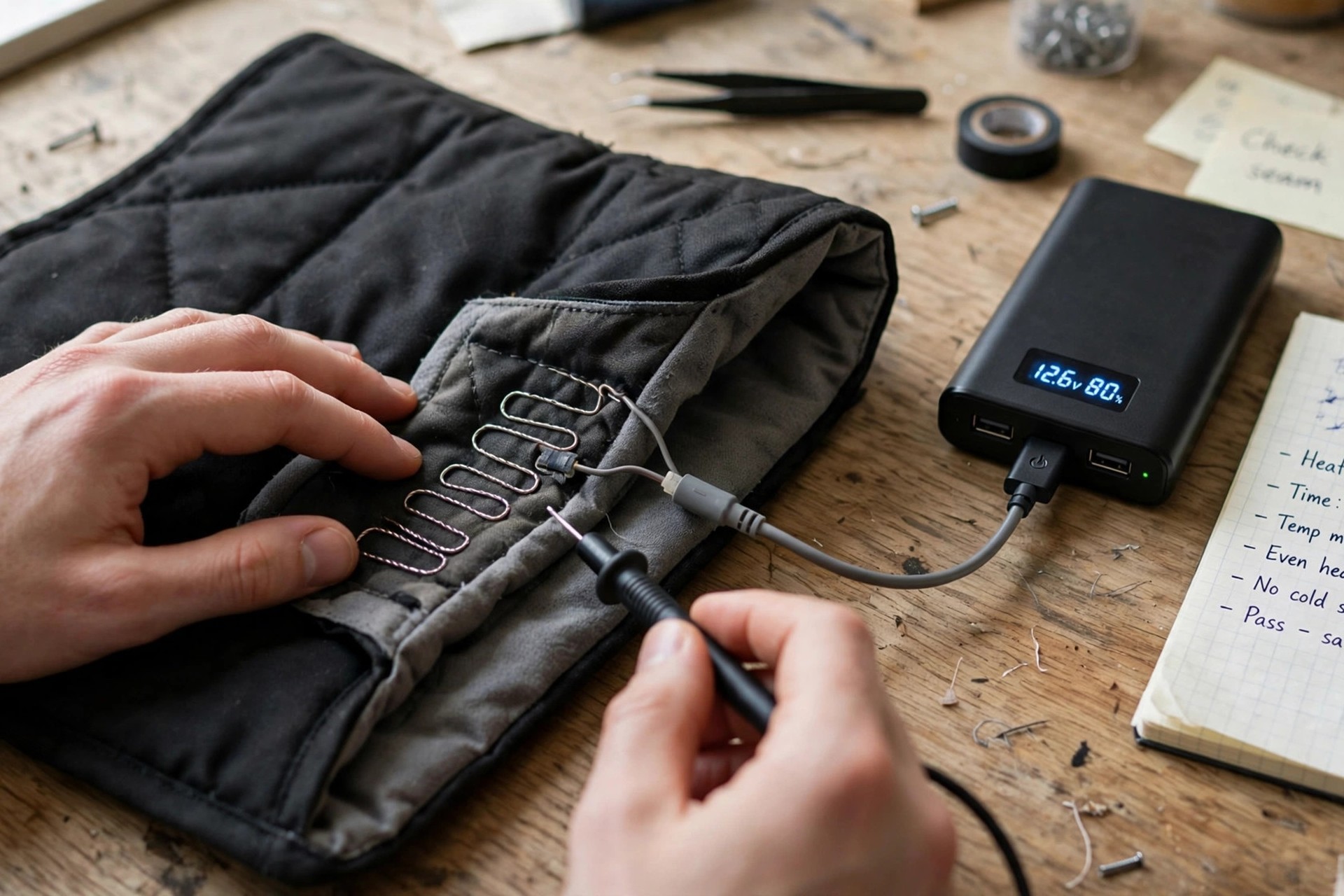
Order samples from three suppliers and test them the same way, in real use, not on a desk. First, run the vest on each heat setting until the battery dies and time it — a claimed 8 hours on low that turns out to be 3 is the most common gap. Second, wash it: remove the battery, wash the vest twice, then check every heating zone still heats evenly — zones that go dead after washing are the top reason for returns. Third, check the battery paperwork before you pay anything: ask for the UN38.3 test report for the exact battery model, confirm the capacity printed on the pack matches the report, and ask whether the supplier has shipped this battery by air before — a vest without air-freight-ready paperwork cannot reach your customers before Christmas, however good the price looks.
4. Private label: cost, MOQ, and the Christmas deadline
Private label is straightforward for this category. Logo embroidery and custom colours are usually cheap at 500+ units, and custom retail packaging adds little on top. Typical MOQ is 2–500 units depending on how custom the order is — stock designs with your logo start at the low end, fully custom colours and cuts at the high end. Lead time is 15–25 days after sample approval, plus shipping, and this season that shipping is air freight: sea freight for Christmas orders is already cut off, so build the air-freight cost and the UN38.3 battery file into your landed-cost calculation from the start. For the EU and US, ask for CE and FCC documentation for the battery pack before you pay the deposit. For the full inspection checklist, see our guide to pre-shipment inspection.
5. FAQ
How long does a heated vest battery last?
It depends on the heat setting and the battery size. A 10,000 mAh pack typically runs 3–4 hours on high and 7–8 hours on low, but treat every runtime claim as a figure to verify on your sample — run it flat on each setting and time it yourself.
Can you wash a heated vest?
Yes, if the battery is removed first. Washability is a real quality split: good vests survive repeated washing with all zones working, cheap ones lose zones after two washes. Test it on your sample before you commit to volume.
What should I check during a pre-shipment inspection?
Test every heating zone on sampled units, confirm the battery capacity on the label matches the UN38.3 report, check the embroidered logo against your artwork, and verify the battery pack is the exact model in the paperwork. For the full checklist, see our inspection guide.
Start with samples, not with a bulk order
A heated vest is a seasonal product with a hard deadline — the buyers who get burned are the ones who negotiate price first and check the battery paperwork last. Test three samples on the same spec sheet, wash them, run the batteries flat, and only then negotiate volume. See our Heated Vest product page for a live example of this category, and pair it with our Rechargeable Hand Warmer for a winter-warmth range. If you want help finding and vetting suppliers for this category, our $129 Sourcing Trial covers five suppliers, a side-by-side comparison, and a recommendation — see our Pricing page for details.
How to source dash cams from China in 2026: dual 4K front + 1080P rear, STARVIS sensor night tests, loop recording and G-sensor locks, heat and parking-mode che···
Как заказать пусковые устройства из Китая в Россию в 2026 году: реальные и заявленные пико···

How to buy from 1688 without speaking Chinese in 2026: browser translation, image search and Chinese keywords, reading price tiers and supplier badges, landed c···