Sourcing references across categories
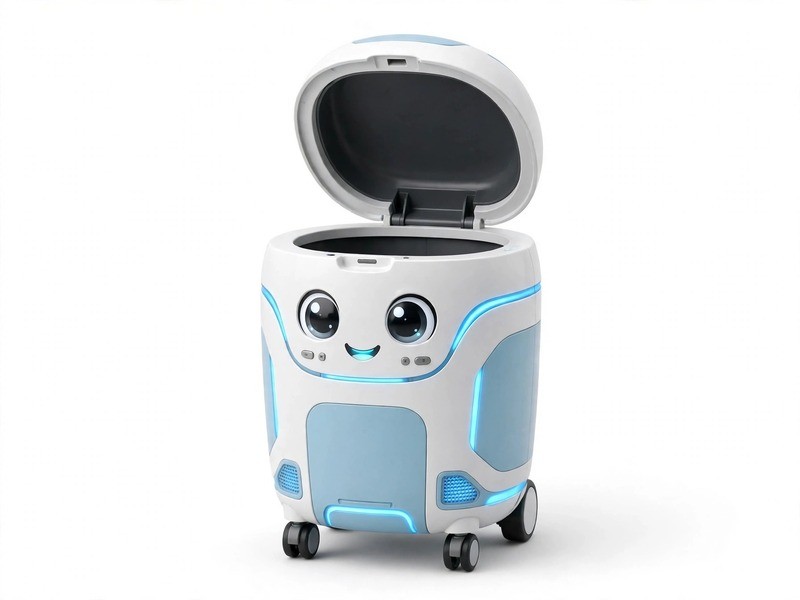
AI smart trash can from China — voice-controlled self-moving robot bin, sensor lid, auto-bagging. ChinaSift verifies the summon demo, samples and paperwork.
AI smart trash can that comes when you call it — the viral home robot of November 2026. Call it by voice, tap the app, or press the remote, and the bin drives over to you on its wheels, opens its lid, and rolls back to its dock when you are done. The demo everyone is sharing is a cute dinosaur-style robot bin (white and light blue, big cartoon eyes) that rolls out from around a corner when summoned; the same idea is already working in public in Shenzhen, where a mobile smart bin at Huangmugang Metro Station drives up to pedestrians and asks for their rubbish.
Under the gimmick is a real product line: sensor lids that open on a wave or a voice command, rechargeable batteries, obstacle-avoidance sensors so it does not bump furniture or feet, and on the better models automatic bag dispensing. Buyers are gift retailers, TikTok sellers and smart-home distributors looking for a novelty line with a demo that sells itself on video — not a municipal waste contract, and not a robot vacuum.
Peer listings in November 2026 put the home range roughly at $9–$60 per unit: the sensor-lid tier (6–12L, wave or voice lid) lists around $4–$12, the auto-bagging tier (12–17L, rechargeable) around $17–$40, and the movable robot-bin tier around $59 retail on Taobao (the DUTE 12L robot-shaped sensor can retails higher, around $80–$108; the Dreame 9L auto-bagging can retails around $48; the Simplehuman voice can retails over $200). MOQ on the sensor tier runs 1–300 units on Alibaba listings; the robot-bin tier's B2B MOQ is not publicly listed — confirm it with the supplier before ordering volume.
What to check on the sample: does the bin actually drive to you on a voice or app summon, or does it only roll on a remote — ask for a live video demo; obstacle avoidance on a real living-room floor with chair legs and cables; lid speed and whether it seals against odour; battery runtime and charging (USB vs dock); whether the bag system is standard bags or a proprietary roll; and the capacity in litres against the listing. Ask for CE/RoHS reports, and UN38.3 if the battery is lithium and the order ships by air.
ChinaSift verifies the self-driving claim on a live demo, the sample against the spec sheet, the certification paperwork, and whether the supplier is the factory or a trading company.